Solving Schema Compilation Latency in Production LLM Inference
- inference
- latency
- llm
- json-schema
- engineering

In short
- Initial latency spikes in constrained decoding are caused by the inference engine mapping complex JSON schemas into a formal grammar state machine.
- Schema compilation time scales exponentially with branching factors and deep nesting, turning simple requests into CPU-intensive tasks.
- Pre-warming worker pools with a 'no-op' request forces the grammar to compile during initialization, moving the latency cost out of the user's critical path.
- Performance stability is best achieved by treating schemas as static infrastructure assets and modularizing complex extraction logic into smaller, flattened definitions.
Eliminating Latency Spikes in Schema-Constrained Inference
<meta_title>Eliminating First-Request Schema Compilation Latency in Production Inference Loops</meta_title>
Constrained decoding in production inference loops introduces a silent "compilation tax" where the engine must build a transition map between the token vocabulary and your schema's constraints. You can eliminate these p99 spikes by pre-warming static schemas across your worker pool during the container startup phase, moving the non-deterministic compilation work out of the user's critical request path.
Technical takeaways
- Initial latency spikes during constrained decoding are caused by the engine mapping the schema's recursive structure to a formal grammar state machine in memory.
- The latency cost of schema compilation scales relative to the branching factor of your schema; every
oneOforanyOfoperator forces the sampler to track multiple competing state paths simultaneously. - Pre-warming worker pools by executing a "no-op" inference call forces the inference engine to commit the compiled grammar to its local cache, pinning the cost to the container initialization phase.
- Predictable p99 response times require treating schemas as static infrastructure assets rather than dynamic request payloads, ensuring the grammar state machine is fully realized before the first user request arrives.
The Hidden Cost of Dynamic Grammar Compilation
The latency cost of dynamic schema generation arises from the engine deriving a Deterministic Finite Automaton (DFA) from your JSON definition, a process that becomes computationally expensive as the grammar's state-space complexity grows. While simple schemas compile in sub-millisecond time, schemas exceeding a branching factor of ~50—or containing more than three levels of recursive nesting—can trigger a state-machine explosion that adds 500ms to 2s of latency to the first token generation.

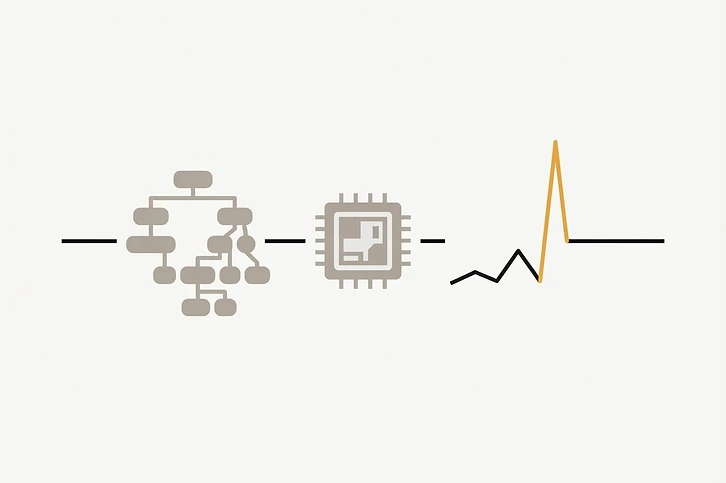
This compilation is non-linear because the engine performs an exhaustive traversal of all valid token paths allowed by the schema. When a schema includes anyOf or deep object nesting, the DFA's transition table size increases exponentially; the engine must maintain an active pointer to every possible terminal branch simultaneously. In practice, this means that even if your model generates a response quickly, the "time-to-first-token" (TTFT) is held hostage by the CPU-bound task of mapping the grammar constraints before the decoder can emit a single logit.
When this fails
This approach fails when your application requires runtime-generated dynamic schemas based on arbitrary user input. In such scenarios, the compilation cost is unavoidable because the schema—and therefore the grammar state machine—is genuinely new to the engine on every request. You must instead simplify the schema by removing recursive structures or deep nesting, which limits the number of state-machine branches the compiler must resolve before generation begins.
Pre-Warming Worker Pools for Stability
You can stabilize your p99 latency by decoupling schema compilation from user traffic through a pre-warming strategy that initializes the grammar before a request is ever routed to the instance. By executing a dummy request against your specific schema during the container's readiness probe, the compiled grammar is stored in the memory of the inference host, ensuring the "heavy lifting" happens before users interact with the system.
We structure our pre-warming logic to execute during the application's readiness probe to ensure that the infrastructure only routes user traffic to instances that have already completed the schema-to-grammar conversion.
import openai

# Pre-warmed schema definition
PRE_WARM_SCHEMA = {
    "type": "json_schema",
    "json_schema": {
        "name": "data_extraction",
        "strict": True,
        "schema": {
            "type": "object",
            "properties": {
                "id": {"type": "string"},
                "score": {"type": "number"}
            },
            "required": ["id", "score"],
            "additionalProperties": False
        }
    }
}

def pre_warm_engine():
    # Execute a non-billing or minimal request to compile the grammar
    client = openai.OpenAI()
    try:
        # Request a single token to force the engine to build the DFA cache
        client.chat.completions.create(
            model="gpt-4o",
            messages=[{"role": "user", "content": "compile"}],
            response_format=PRE_WARM_SCHEMA,
            max_tokens=1
        )
    except Exception as e:
        print(f"Pre-warm failed: {e}")
When this fails
This technique is ineffective in serverless architectures that aggressively scale to zero, as the latency is reintroduced with every cold start. If your infrastructure relies on ephemeral instances, pre-warming only mitigates the "warm-up" period of that single instance and cannot account for the overhead of the cold boot itself.
Managing Schema Complexity and Limits
The complexity of your JSON schema directly dictates the compilation time, as deep nesting and excessive constraints increase the size and fragmentation of the grammar state machine. Keeping your schema structure lean is essential, as the engine must map every potential token transition allowed by your definition, and overly complex schemas cause the memory overhead for the grammar cache to spike.

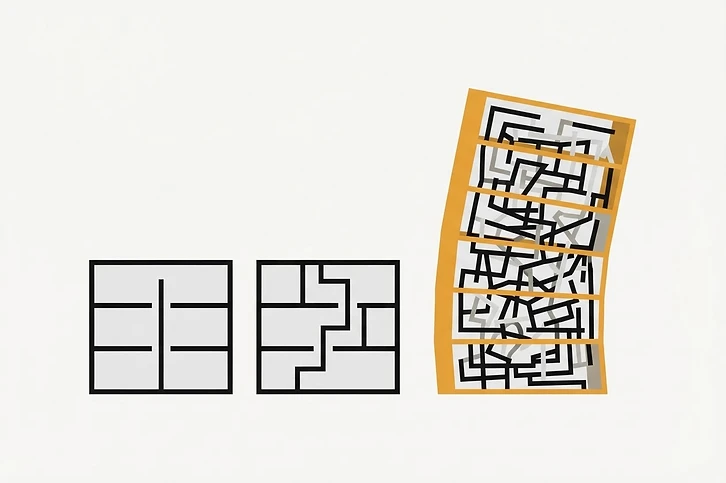
The most counterintuitive outcome of complex schemas is that they can degrade not just the first request, but the stability of subsequent tokens; when the grammar is highly fragmented, the sampler must perform more exhaustive look-ahead checks at every step of the generation process. To keep latency predictable, we enforce these design constraints:
- Flatten schemas to a maximum of three nesting levels to minimize branch pathing.
- Use strict types and avoid optional fields where possible to collapse the search space.
- Eliminate redundant constraints that force the grammar compiler to validate overlapping logic.
Avoiding Branching Explosions
Contextual overhead is minimized by aligning your system prompts with a strict, predictable output format, which prevents the engine from performing unnecessary reasoning cycles. When the schema contains large enum fields, the compiler must map every unique value as a valid completion path. If you have hundreds of options, you are effectively asking the engine to keep an exhaustive index of those values in the active grammar, which significantly increases the latency for the very first token.
If you are struggling with consistent latency, reduce the number of branching paths by splitting the extraction logic into modular steps. Instead of one massive schema that covers every possible output type, define smaller, highly specific schemas for individual tasks. By modularizing your schemas, you minimize the work the grammar compiler performs per request and keep the memory overhead of the state machine within a predictable, low-latency threshold.
Want the prompt this article describes, built for your own objective?
Engineer one now — free, no account needed